Quiet intelligence for every construction decision.
One model of your firm — every job, draw, crew, and obligation — run by a core that works inside the systems, the crews, and the standards that built it. Nothing replaced. Everything connected.
In construction, the reward for structure is the largest. We read your world the way your estimators do — and what we build is engineered, inspected, and meant to hold.
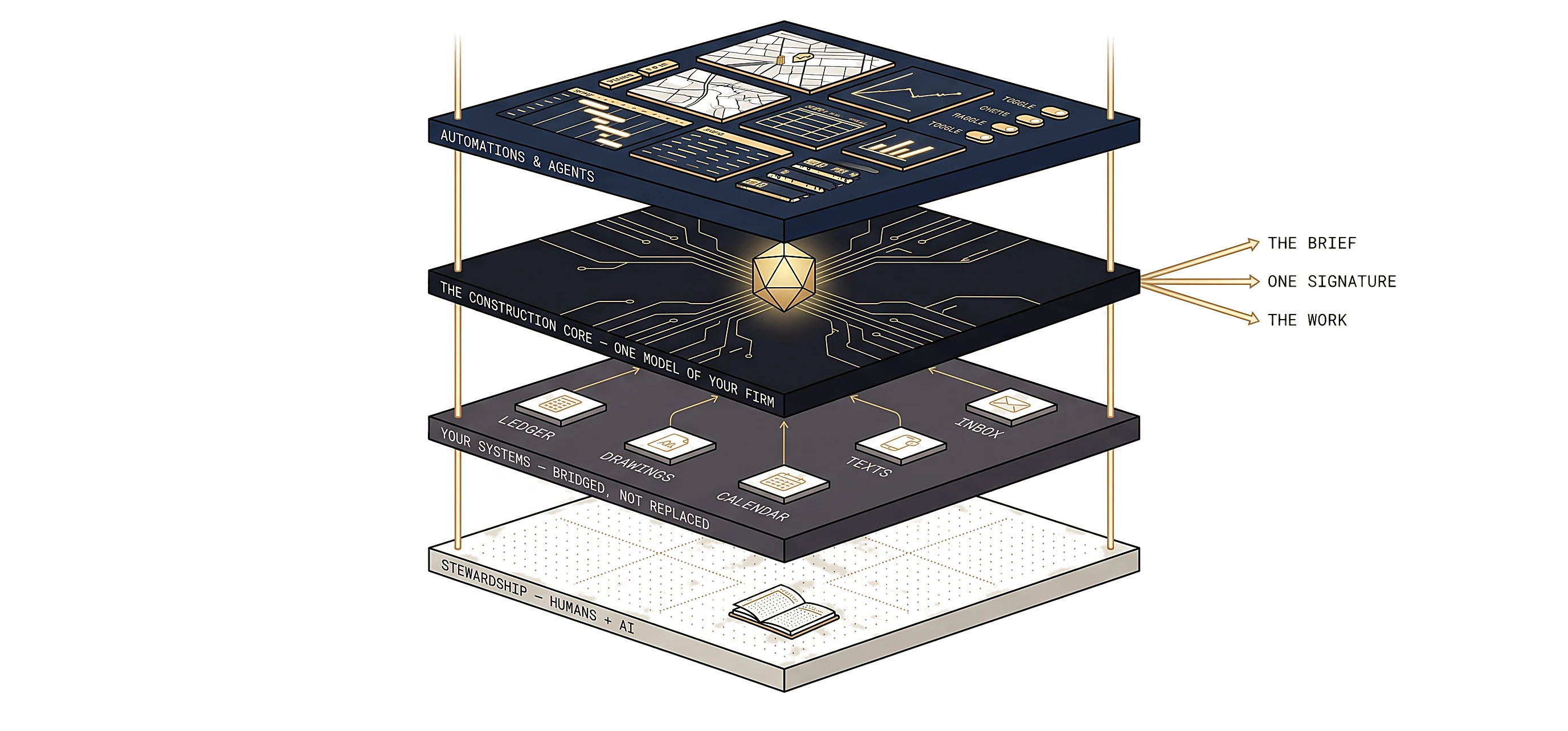
The Construction Core is an ontology — a living model of your business in which every object the firm runs on is defined once and synchronized everywhere. Your accounting, your scheduling, your drawings, your field messages: bridged, not replaced. The AI is only the polished glass on top; the model underneath is the instrument.
The Core standardizes how the office and the field speak about the same things. A draw means the same thing to the project manager, the bookkeeper, and the bank; a crew’s day exists once, not five times in five systems. One vocabulary, kept.
It is built from the field first. The job site is where the record is made — so the Core meets it over text message, in plain language, from any phone in any truck. Nothing new for the crew to learn, and nothing lost between trailers.
Between your systems and your decisions, the Core is the bridge. It reads the ledger, the drawings, the calendar, the texts, and the inbox — and returns the brief, the signature, and the finished work: the delay predicted before it lands, the sub papered before the pour, the draw out the day the milestone hits.

The work doing itself — intake answered, records filed, invoices out — always within rules you set and sign.
The model of your firm. Every job, dollar, and document as one connected body of knowledge.
Humans and machine, in daylight. Every automated action logged, traceable, and visible to you.
A bid is won in the hours between the drawings arriving and the number going out — and most of those hours are spent hunting, not thinking. Takeoffs, specification reading, and pricing get compressed until judgment is the first thing cut.
The Core reads what you build from. Drawings, specifications, and your own bid history become one searchable body of knowledge, so estimating shifts from gathering to deciding — and the number that goes out is sharper for it.
Plans and specifications parsed into quantities, scopes, and flags — read closely, indexed completely, remembered forever.
Quantities extracted from drawings and standardized into priced line items.
Scope letters, exclusions, and proposals composed in your house voice, ready for signature.
Every past bid, win, and loss quietly informs the next number.
Work arrives by phone, text, referral, and ad — and the firm that answers first usually wins. But when intake belongs to whoever is least busy, leads die in trucks and notebooks.
Every inquiry enters the Core the moment it exists: answered in minutes, qualified by your rules, and set against a calendar of crews and jobs that is kept as one living picture.
Calls, forms, and ad leads land in one intake and receive an answer in minutes, not days.
The serious separated from the curious — by standards you set, not a script.
Crews, equipment, and jobs on one calendar that updates itself as the week moves.
Next week's conflicts surfaced this week, while they are still cheap to fix.
The job site is where the money is made — and where the record dies. Hours live on paper, progress lives in photos never filed, and problems surface at the end of the month instead of the hour they happen.
The Core meets the field where it stands: over text message. Timecards, daily logs, and photos flow in from the crew's pockets and land structured — filed against the right job, ready to bill.
Foremen text in plain language; the system files, schedules, and answers.
Hours collected, totaled, and posted to jobs — no Friday hunt.
Field records that file themselves against the job, the date, and the drawing.
Delays, shortages, and incidents raised the hour they happen — not at month-end.
Iron that sits still costs like iron that works. Materials run out mid-pour because the reorder lived in someone's head, and the rental that should have gone back last Tuesday is still on the invoice.
Every machine and every material becomes an object in the model — where it is, what it costs, when it runs out — with the reorder written before the shortage and the return flagged before the bill.
What every machine did, on which job, at what cost — kept without asking.
Equipment sitting still, rentals running long, costs passing revenue — surfaced early.
Service intervals tracked per machine, downtime scheduled around the pour — not during it.
Returns flagged before the next billing cycle. Iron leaves the ledger the day it leaves the site.
Every subcontractor is leverage and liability in the same envelope. Certificates lapse, lien waivers go unsigned, and the paperwork that protects the firm is precisely the paperwork nobody has time to police.
The Core keeps the file complete on its own: certificates current, waivers collected, scorecards kept — so that trust is documented, not assumed, and audits find nothing to find.
Certificates and licenses tracked to their expiry, renewed before they lapse.
Waivers requested, chased, and filed with every payment — automatically.
Performance, punctuality, and paper kept per sub — so the next award is informed.
Inspections scheduled, punch lists tracked to closure, records kept to daylight.
Margin is decided in the paperwork nobody enjoys: pay applications, draws, retainage, change orders, receivables. The work gets done; the getting-paid falls behind it.
Billing leaves the same day the milestone is hit. Draws assemble themselves, retainage is tracked to the dollar, change orders are papered before the work — and the books stay closed to yesterday.
Applications and draw packages assembled from the record, not the memory.
Priced, papered, and approved before the work — never after the argument.
Politely, relentlessly, automatically — until the money is in.
Held and released on schedule, tracked line by line.
Procurement is decided in the gap between the takeoff and the purchase order — and that gap is where prices drift, lead times lie, and the pour date quietly loses its margin. The firm that buys well buys early, and buying early takes a record most firms do not have time to keep.
The Core keeps it. Material runway is measured against the schedule, reorders are drafted before the gap opens, and every vendor’s prices, lead times, and reliability are remembered — so the next buy is informed by every buy before it.
Burn-down against the schedule, with reorders drafted before the gap.
Prices, lead times, and reliability of every supplier — remembered and compared.
Purchase orders drafted from the estimate’s own line items, priced from history, ready for signature.
Deliveries tracked to the pour date; slippage raised while alternatives still exist.
The back office is where every mile of the value chain becomes either a clean record or a Friday night. Hours, invoices, receipts, and change orders arrive from everywhere and land on the same two desks — and the firm’s real margin is decided by how much of it lands twice.
In the Core, it lands once. Field hours become job-costed entries, documents file themselves against the job and the date, and the books stay closed to yesterday — so the quarter ends with a handoff, not an excavation.
Every transaction categorized against its job. Bookkeeping current, CPA-ready.
Field hours land as job-costed payroll entries, ready to run — no chasing, no re-keying.
Every document filed against the job, the date, and the drawing — findable in seconds, years later.
A clean handoff to your CPA. The shoebox retires.
What the model looks like the morning it goes to work — the brief, the jobs, the week, and the money, drawn from one record.
CAT 336 idle three days on FM 1626. Redeploy or return before Friday’s rental cycle.
OPENHangar 3 steel running 4.2% over baseline. Change order drafted for signature.
DRAFTEDRidgeline 14 — pour window holds. Pump confirmed for 6:40, mix ticket on file.
Draw 07, Mercy East — assembled overnight. One signature releases $148,200.
CAT 336 — idle three days on FM 1626. Return or redeploy before Friday’s rental cycle.
| JOB | PHASE | DRAW | NEXT |
|---|---|---|---|
| Ridgeline 14 | Foundations | 03 · PAID | Pour Tue |
| Mercy East Tilt-Up | Panels | 07 · READY | One signature |
| FM 1626 Box Culvert | Earthwork | 02 · SENT | Inspection Thu |
| Hangar 3 Retrofit | Steel | 05 · DRAFTED | RFI 041 answer |
Felipe is our command line — the firm’s back office, resident in your phone. The field texts him like a person; he files, schedules, chases, and answers like an office that never closes.
He reads the same model as everything on this page — every job, crew, machine, and dollar — so his answers are the firm’s answers.
LICENSED ON HIS OWN · OR RESIDENT INSIDE YOUR CORE
A design partner on what changed — in his own words, from his own site. In production now.
WATCH THE FILM ↳ RESERVEDThree founding slots, priced to be accepted. Your results publish here — in your words, not ours.
REQUEST A SLOT ↳Every deployment adds a numbered entry — reported, dated, and signed by the firm that lived it.
NEXT ENTRY · YOURSWe work the way the great platform firms work — one deployment, one license, one published ladder. No timesheets, no scope creep, no renegotiation disguised as a meeting.
A fixed fee. Your live data. A resident engineer builds the Core on the systems you already run — working in days, not quarters.
You see it running before you commit to keeping it.
A monthly license scoped to active jobs, seats, and connected systems. The meter is published and it never surprises.
The system earns its keep every month, or you stop paying for it.
New workflows, new divisions, new systems — at pre-published pricing, added when you ask. Growth is never a renegotiation.
The ladder is printed before you need it.
Strumode holds access, never custody. Your records stay in your systems, under your ownership, inside your perimeter — we bring the intelligence to the data, not the data to the intelligence.
Separate tenancy, credentials, and service accounts per client. Nothing shared, nothing pooled.
Every automated read and write is logged and visible to you. The system works in daylight.
AI providers run under zero-data-retention terms. Your records are never training data.
Data processing agreements in every contract. Insurance carried. Exits honored — it is your data, always.
We are engineers and architects of software. We know a draw schedule from a drawing schedule — and we build operational systems the way you build structures: to code, and to last.
Your deployment is led by a resident engineer who comes to the work — the yard, the trailer, the morning meeting — not a consultant who has seen it only in a deck.
Every machine-hour, load, and draw lands in the same model the estimate came from. Nothing is retyped. Nothing is lost between trailers.
Construction is leaving the ground — data centers in orbit, pads beyond it. The firms that go will need a spine that goes with them.
What serious rooms are writing about computing’s next site — the case for it, and the case against. The record travels; so will the work.

Project Suncatcher: constellations of solar-powered TPU satellites, linked by light — prototype spacecraft slated for 2027.
READ AT GOOGLE RESEARCH ↳
A training run completed in orbit — the opening move in the off-planet data-center race.
READ AT CNBC ↳
The sober ledger — launch, power, and replacement still set a hard price on compute in orbit.
READ AT TECHCRUNCH ↳
A million-satellite filing, weighed against the physics — the argument from the skeptics’ bench.
READ AT IEEE SPECTRUM ↳Gigawatt campuses, built at sprint pace by the firms we serve. The heaviest construction season in a generation is a computing project.
Data centers in orbit. Intelligence beyond the grid. The work is leaving the ground — and the record travels with it.
Whoever builds off this planet will run on an operational spine engineered like this one. We are starting with the ground floor — and keeping the drawings for what comes next.
Bring us one estimator's week, one foreman's Friday, or one month of getting paid. We will show you what it looks like when it runs itself.
Book a free demo →